CIRCONOMY is an EU-funded project supporting Europe’s transition to a circular economy by developing practical, harmonised micro-level circularity indicators to better measure and understand circularity across companies, municipalities and households.
CIRCONOMY helps Europe move faster towards a circular economy by making it easier to understand and measure how resources are used and reused in everyday life. Today, most available data on circular economy performance is too general to help local authorities, companies, or citizens take practical action.
CIRCONOMY will develop a new way to measure circularity using clear and practical indicators that work at local level. These indicators will be integrated into a simple digital tool designed to help municipalities, businesses, and households understand their impact and identify ways to improve.
The project combines scientific research with real-world needs, bringing together environmental studies, social sciences, and digital technologies. This ensures that the tool is both reliable and easy to use across different countries and contexts. The tool will be tested in real situations with companies, municipalities, and households to make sure it works in practice and can be widely applied.
In addition to the tool itself, the project will provide training materials, practical guides, and workshops to help people and organisations apply circular economy principles in their daily decisions. It will also support evidence-based decision-making and policy alignment, helping ensure coherence with key European frameworks and strengthening the link between circularity metrics, governance, and policy development.
Ultimately, CIRCONOMY will make circular economy concepts more concrete and actionable, helping Europe better monitor progress towards circularity and support wider climate, biodiversity and sustainability goals.
CIRCONOMY aims to accelerate Europe’s transition towards a sustainable circular economy (CE) by developing a harmonised, operational framework of micro-level CE indicators. While macro-level frameworks provide valuable aggregated data, they lack the level of detail needed for municipalities, companies, and households to make informed decisions and to support behavioural change and investment strategies.
To bridge this gap, CIRCONOMY will develop a modular, user-focused monitoring framework and an intuitive digital tool that combines scientific rigour with practical usability. The project adopts a participatory, interdisciplinary approach, integrating life cycle thinking, environmental footprint methods, social sciences, and digital innovation to develop a robust, inclusive, and adaptable framework across diverse socio-economic and territorial contexts.
A key innovation of CIRCONOMY lies in its multi-scale and multi-actor approach, enabling the assessment of circularity performance at municipal, industrial, SME, and household levels. The system is developed through iterative co-creation, piloting, and replication activities to validate its usability, scalability, and transferability across diverse European contexts.
Beyond technical development, CIRCONOMY advances capacity building and stakeholder engagement through targeted toolkits, training resources, and communication strategies. These are designed to facilitate uptake by municipalities, industry actors, SMEs, and citizens, supporting the integration of circularity metrics into both operational and strategic decision-making.
Policy alignment is ensured through continuous alignment with key EU policy frameworks and initiatives, including the Circular Economy Action Plan, the EU Taxonomy, and the Corporate Sustainability Reporting Directive (CSRD). The project will deliver actionable policy briefs and recommendations to support institutional uptake and harmonisation efforts.
By bridging circularity measurement with governance, financial decision-making, and citizen participation, CIRCONOMY translates circular economy principles into practical, context-specific, and socially inclusive practices, strengthening Europe’s monitoring infrastructure for the circular economy transition and supporting the implementation of the European Green Deal objectives.
Assessment of existing circular economy frameworks to identify methodological and usability gaps for micro-level applications.
Design of a modular, user-centred framework and digital tool prototypes for micro-level circularity monitoring.
Pilot testing in municipal, household and industrial real-world contexts to validate usability and performance of the framework and digital tool prototypes.
Iterative improvement and refinement of the framework and digital tool based on pilot feedback, addressing identified technical, methodological, and usability issues.
Deployment of the refined framework and digital tool in diverse European contexts to test transferability, interoperability and assess adaptability and scalability under varying conditions.
Enhance stakeholder awareness, knowledge and capacity and support long-term adoption through practical toolkits, targeted training, and policy recommendations. Foster behavioural change and institutional uptake through targeted communication and engagement strategies.
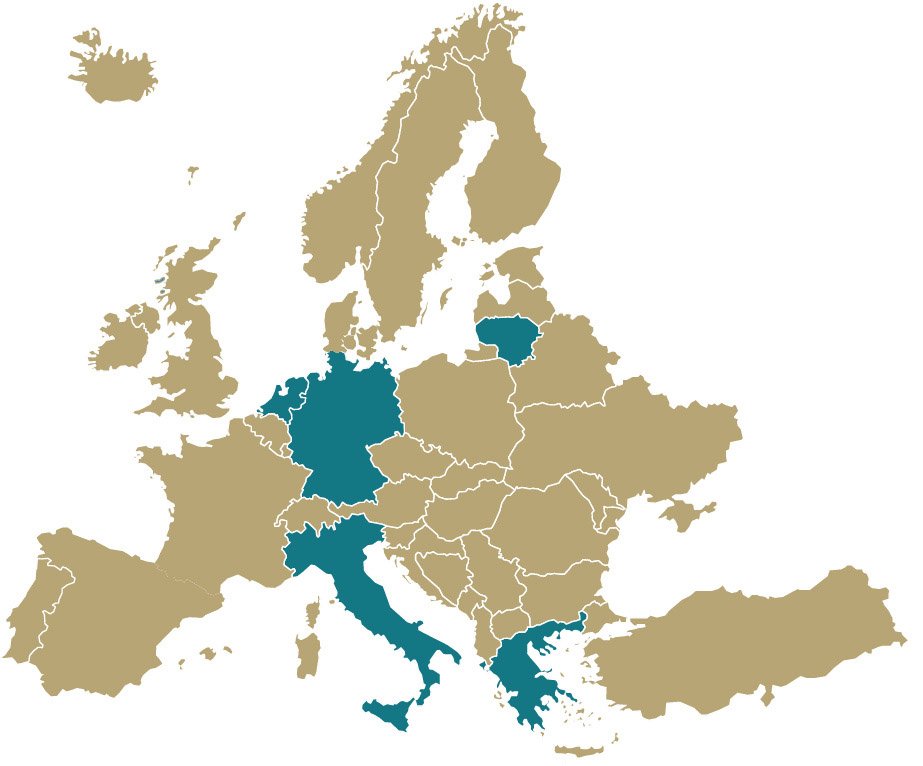
Household pilot – Italy
Industrial replication – Italy
Municipal pilot – Thessaloniki, Greece
Industrial pilot – Germany
Municipal replication – Amsterdam, Netherlands
Household replication – Lithuania

